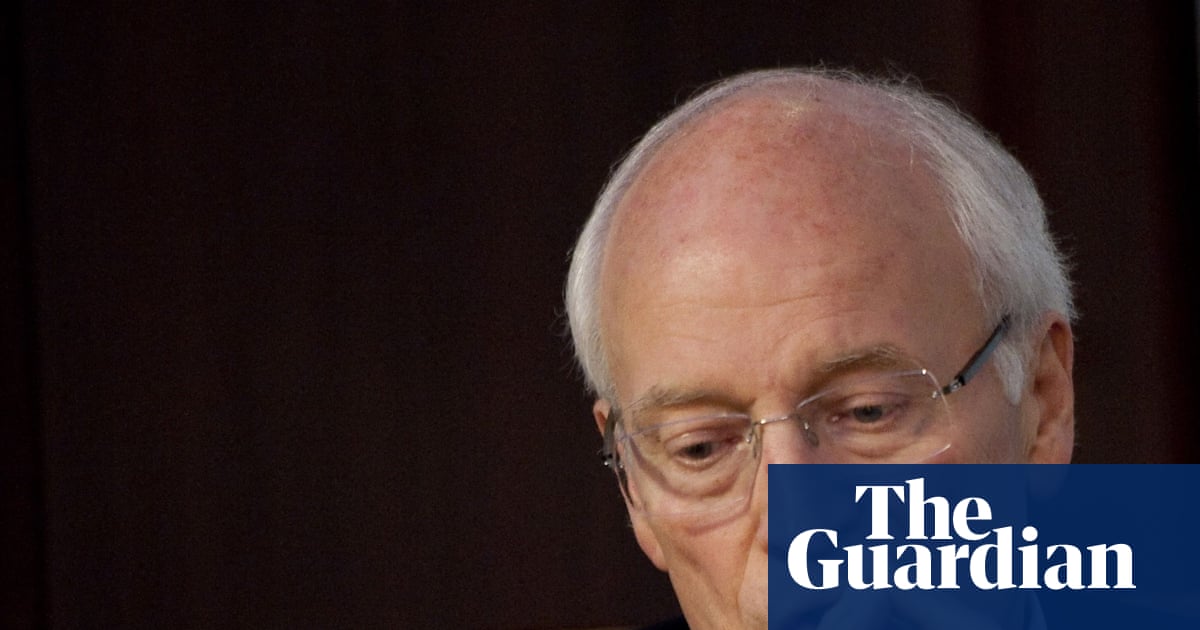

Dick Cheney, the polarising former US vice‑president who played a central role in the George W. Bush administration and was a key architect of the decision to invade Iraq, has died at age 84, his family said.
Cheney’s long Washington career spanned Congress, White House chief of staff, secretary of defense and, most consequentially, the vice‑presidency. He was widely viewed as one of the most powerful vice‑presidents in US history, exerting strong influence over a comparatively inexperienced president and helping shape the post‑9/11 security agenda.
He was in office on 11 September 2001 and, in the immediate aftermath of the terrorist attacks, took a central policy role alongside defence secretary Donald Rumsfeld as the administration mobilised. US forces moved into Afghanistan to confront the Taliban and pursue al‑Qaida.
Cheney’s legacy is most closely associated with the 2003 invasion of Iraq. Having served as defence secretary during the 1990–91 Gulf war, he was a leading advocate within the Bush administration for removing Saddam Hussein. The public rationale for war cited alleged links between Iraq and al‑Qaida and claims Iraq possessed weapons of mass destruction; those claims were not substantiated by the time coalition forces invaded in March 2003 and were later discredited. Cheney wrote that the administration believed it “had an obligation to do whatever it took to defend America,” and argued the mission should determine the coalition rather than vice versa.
The human toll of the ensuing conflicts was high. Researchers at Brown University’s Watson Institute estimate that since 2001 at least 800,000 people have died from direct war violence across Iraq, Afghanistan, Syria, Yemen and Pakistan. The US treatment of detainees during the “war on terror” drew intense criticism; Cheney remained a defender of harsh interrogation techniques after leaving office.
Cheney rose despite setbacks: a Yale dropout who avoided service in Vietnam, he served as an aide in the Nixon White House, became Gerald Ford’s youngest-ever chief of staff, was a congressman under Ronald Reagan and served as secretary of defense for George H. W. Bush. He spent time in the private sector with Halliburton before joining George W. Bush as his running mate in 2000. His career included serious health problems—he survived three heart attacks—and personal embarrassments, including the widely publicised hunting accident in which he accidentally shot a companion.
In later years his health remained a concern; he underwent a successful heart transplant in 2012 and was described by his physician as open about his illness and highly compliant with treatment, which was credited with extending his life.
Cheney’s political legacy continued through his daughter, Liz Cheney, who won his old House seat representing Wyoming. She later broke with much of the Republican Party over Donald Trump and was censured by party officials after condemning the January 6 attack on the US Capitol. On the first anniversary of January 6 the elder Cheney said he was “deeply disappointed” by contemporary Republican leadership and warned of the event’s significance.
In 2024 Cheney said he would vote for the Democratic ticket rather than the Republican nominee, calling Donald Trump “a greater threat to our republic” than any prior individual and saying he felt obliged to put country above party to defend the Constitution.
Biographers and commentators have noted Cheney’s comfort with a fearsome reputation. Jake Bernstein, who wrote about him around the release of the film Vice, observed that Cheney appeared to relish being portrayed as a dark, influential figure and showed little inclination to soften that image.
Cheney’s death closes a life that loomed large in Republican politics and helped reshape US foreign and security policy in the early 21st century, with consequences that continue to reverberate.