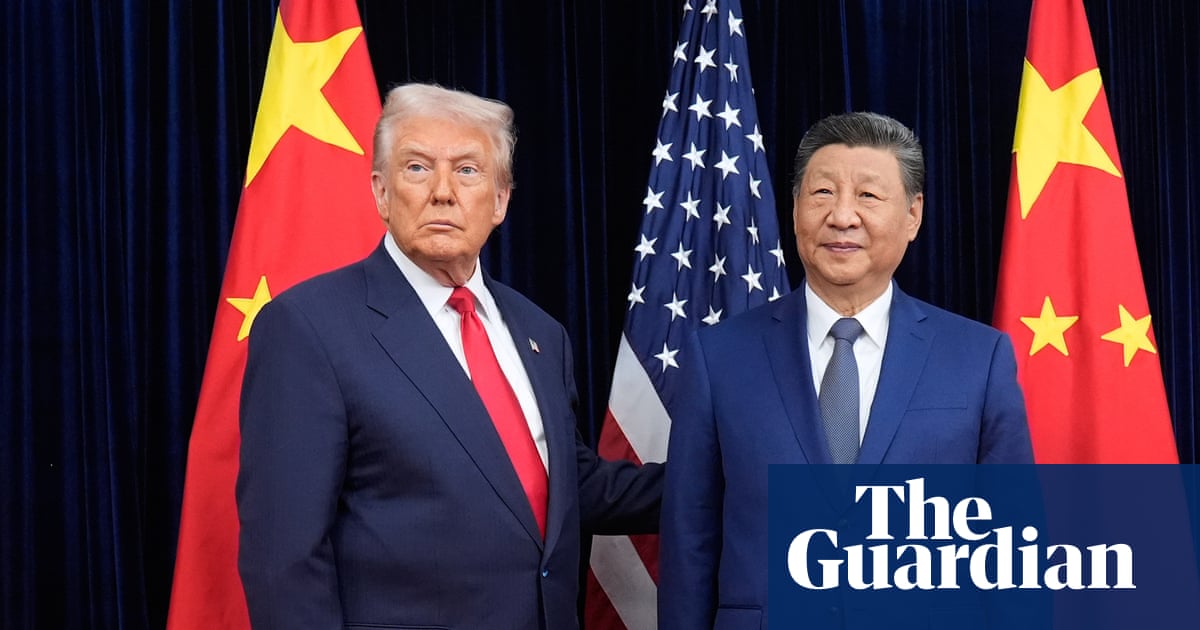

Donald Trump described a face-to-face meeting with Chinese president Xi Jinping in Busan as “amazing,” saying the two leaders had resolved a dispute over rare earth exports and agreed other trade measures, and that he plans to visit China in April.
Chinese state media quoted Xi as saying economic and trade teams from both countries had “reached a basic consensus on addressing our respective major concerns” during earlier talks in Kuala Lumpur, creating the conditions for Thursday’s summit. Beijing’s commerce ministry said the Kuala Lumpur agreement included a 10% reduction in the US “fentanyl tariff” and reciprocal Chinese steps to suspend certain export controls.
After roughly an hour and 40 minutes at Gimhae airbase, the leaders shook hands and Trump returned to Air Force One. He told reporters Xi had agreed to work “very hard” to curb production of fentanyl-related materials, and in exchange the US would cut a fentanyl-linked tariff from 20% to 10% — a move Trump said would reduce overall tariffs on Chinese goods from 57% to 47%.
Trump said China would end restrictions on rare earth exports and begin buying US soybeans. He described the rare earth arrangement as a one-year accord to be renegotiated annually, and declared: “All of the rare earth has been settled.” Reuters had reported that China already bought its first US soybean cargoes in months ahead of the talks.
The pair also discussed Ukraine, Trump said, and agreed to try to work together on the conflict; other topics received less attention. Taiwan was not raised at the summit, and Xi did not respond publicly to Trump’s comments on Thursday.
Xi urged the two countries to “stay on the right course” and play a responsible role as the world faces major challenges, saying it was normal for major economies to have occasional frictions but that recent talks had made “encouraging progress.” He noted he and Trump had not met in person since 2019, though they have spoken by phone and exchanged letters since Trump returned to the White House.
The tone in Busan contrasted with recent escalation over trade: Beijing had proposed widening curbs on rare earth exports — critical for electronics and defence manufacturing — prompting Trump to threaten steep retaliatory measures, including potential 100% tariffs. This summit appears to have de‑escalated that immediate crisis.
Shortly before meeting Xi, Trump posted that he had ordered the Pentagon to begin testing US nuclear weapons “on an equal basis” with Russia and China; he did not address the post during the summit. Trump rated the meeting “a 12 on a scale of one to 10” and indicated further diplomatic engagement, including a planned visit to China in April.
Reporting also noted that the rare earth arrangement is intended to be temporary and annually reviewed, and that details on how export controls and purchases will be implemented remain to be worked out by trade teams.