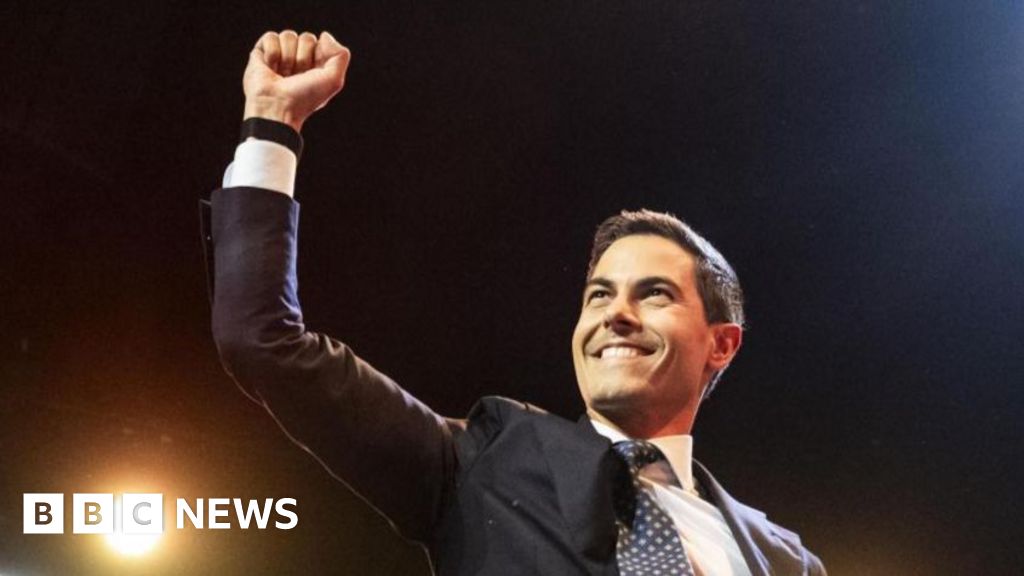

Dutch vote projections showed a dramatic photo-finish between Rob Jetten’s centrist-liberal D66 and Geert Wilders’ anti-Islam Freedom Party, with both parties heading for about 26 seats in the 150-member parliament as nearly all ballots were counted. A projection from Dutch news agency ANP, issued with roughly 98% of votes tallied, put the two parties dead even.
Initial exit polls had given Jetten the lead and his campaign framed the night as a turning point. He told supporters that millions of voters had “turned a page” and rejected a politics of negativity. Wilders, who had led opinion polls through much of the campaign, conceded that the result was below his hopes after losing around 11 seats, but stressed it remained one of his party’s stronger performances.
The margin between the frontrunners was extremely narrow: at one point Jetten’s D66 led by fewer than 1,400 votes with only a handful of results outstanding. Several other parties trailed closely. The conservative-liberal VVD looked set to win about 22 seats, while the left-wing alliance of Labour and GreenLeft and the Christian Democratic CDA were also in striking distance.
Wilders’ campaign suffered from the political reality that most mainstream leaders ruled out working with him after he dissolved his own coalition in June amid a row over asylum and migration policy. That move, combined with worries about his ability to assemble partners, likely cost him moderate voters and made it harder for the Freedom Party to convert poll leads into a governing mandate. Wilders acknowledged he had limited prospects of forming a government but argued that, should his party top the poll, it ought to get the first chance to try.
For D66, the result marked a remarkable recovery. Just weeks earlier some polls had put the party on roughly 12 seats, but a polished campaign, strong performances in televised debates and interviews, and the public profile of their 38-year-old leader helped propel the party upward. Jetten’s appearances even included participation in a televised quiz show in the run-up to the vote, which raised his visibility.
Dilan Yesilgöz’s VVD also enjoyed a good night and was widely seen as a natural partner in any coalition Jetten might try to assemble. Jetten said he would seek a broad, “stable and ambitious” coalition and identified several possible partners: the Labour–GreenLeft bloc led by former European Commissioner Frans Timmermans, the VVD, and a reinvigorated CDA.
The immediate fallout hit Timmermans’ camp hard. The Labour–GreenLeft alliance had expected to finish higher but was projected to come fourth; Timmermans described the outcome as deeply disappointing and announced he would step down and take responsibility for the result.
Analysts said Wilders lost ground on multiple fronts — both to parties on his right and to more moderate options — though losses could have been sharper given that he had broken up the previous coalition and ran a less active campaign than some rivals. Wilders vowed to remain active in politics and told supporters he had no plans to bow out.
Scenes at D66 events were jubilant. Supporters gathered in Leiden chanted slogans and celebrated what the party called its best-ever result. Jetten, who could become the youngest prime minister in the Netherlands in modern times if he succeeds in forming a government, told the crowd he felt a heavy responsibility to all voters and pledged to show that politics and government can again be effective.
Key issues that shaped the vote included migration and overcrowded asylum centres, but the dominant domestic concern was the chronic housing shortage — an estimated shortfall of nearly 400,000 homes in a population of about 18 million. D66 has proposed an ambitious house-building plan that includes creating 10 new cities to help address the crisis.
The CDA also enjoyed a resurgence, moving from a low point two years ago to projections of roughly 18 seats, prompting cheers from its supporters and leader Henri Bontenbal. The overall outcome leaves the Netherlands with a fragmented parliament and the task of coalition-building ahead: even a narrow lead for either Jetten or Wilders will require negotiations with multiple parties to assemble a working majority.