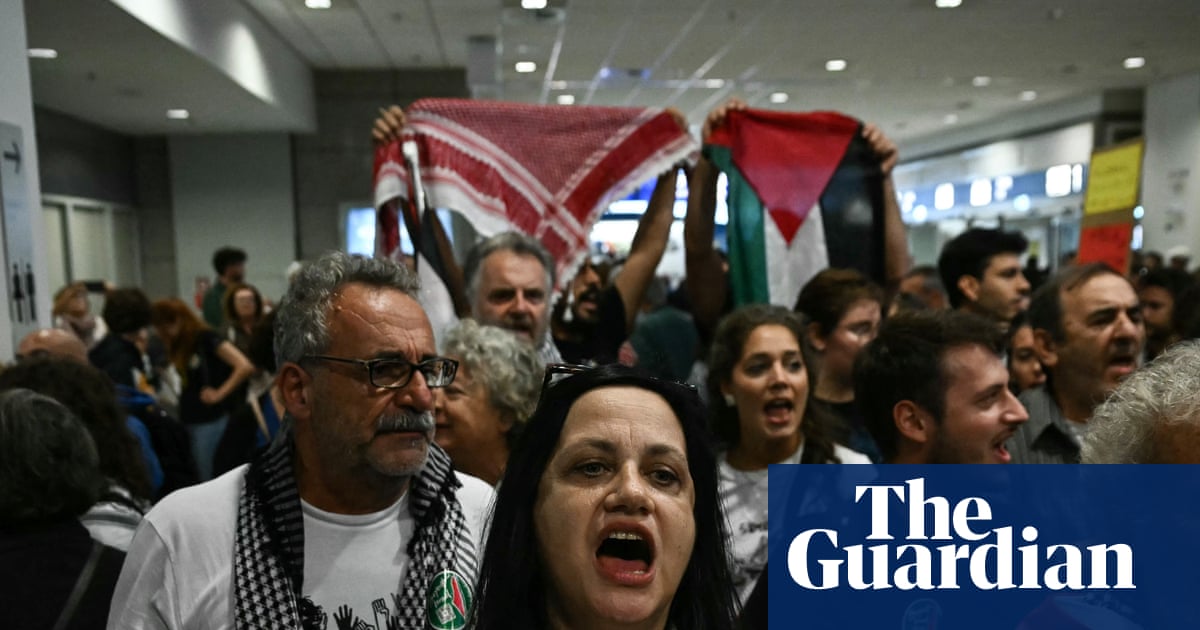

Greek authorities have boosted security at two Peloponnese ports after demonstrations aimed at an Israeli cruise liner carrying tourists on an 11‑day Mediterranean itinerary. Police tightened measures at Patras and Katakolo following protests when the MS Crown Iris called at Kalamata earlier this week.
The heightened precautions come after the same ship had been prevented from allowing passengers ashore in July, when islanders on Syros staged a protest in solidarity with Palestinians and the vessel was rerouted to Cyprus.
Participants in this week’s Kalamata demonstration said they felt compelled to act in response to events in Gaza even after a ceasefire that came into effect on 10 October. Christina Lada, a schoolteacher who joined the protest, said: “Despite the ceasefire, Israel is still continuing its attacks in Gaza. Innocent, unarmed civilians are being killed.” Passengers watched from the ship’s upper deck and on buses escorted by armed officers as crowds chanted that visitors were “not welcome in Greece.”
Organisers of the protests say their anger is driven by Greece’s proximity to the region and longstanding ties to the Arab world. Yannis Sifanakis, a campaigner who coordinated anti‑war demonstrations across Greece this summer, said many locals do not welcome Israelis who support the government’s actions. International relations expert Constantine Filis of the ACG Institute noted that Greeks are particularly sensitive to developments in Gaza because of geographic and cultural links, while also stressing that Israel is a significant ally: “Greece is not going to risk its relations with Israel,” he said, but added Greece must show humanitarian concern and balance.
The demonstrations have put the centre‑right government of Prime Minister Kyriakos Mitsotakis on the defensive, and some hospitality groups and municipal authorities have condemned the protests as antisemitic. Israel’s resident ambassador, Noam Katz, criticised Athens’s mayor, Haris Doukas, for not doing more to remove what he described as antisemitic graffiti by organised radical groups that is making Israeli visitors uncomfortable.
Victor Eliezer, secretary‑general of the Central Board of Jewish Communities in Greece, acknowledged criticism of Israeli government policies but warned that heated rhetoric can easily slide into antisemitism. He described the protests targeting the Crown Iris as “a particularly unpleasant phenomenon.”
Tourism ties between the two countries are substantial: official data show more than 600,000 Israelis visited Greece in 2024, with expectations of higher numbers this year. Relations have warmed significantly since the 1980s; Athens was the last EU capital to officially recognise Israel, a step taken by Konstantinos Mitsotakis about 35 years ago, and since 2010 the two nations have cultivated a strategic partnership encompassing economic, diplomatic, military and energy cooperation.
Beyond the cruise incidents, protests have targeted bilateral military links. As many as 5,000 people travelled to Crete to call for the closure of the Souda Bay naval base, a Nato facility that has been used for refuelling US aircraft and ships headed for the region since the outbreak of war in Gaza. Petros Constantinou, coordinator of Keerfa, Greece’s anti‑racist movement, said the campaign has had “victories” and called for an end to cooperation with Israel.
Greek authorities say they are balancing the need to protect visitors and local order with the political sensitivities of a population divided over the conflict in Gaza.