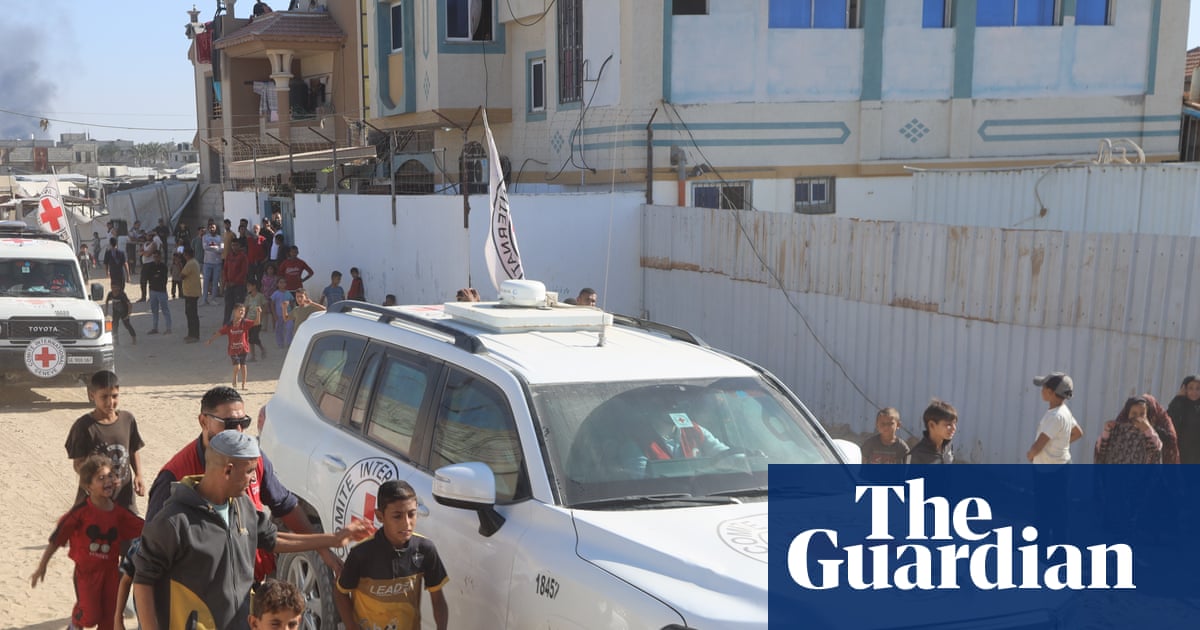

The International Committee of the Red Cross (ICRC) accompanied members of Hamas into parts of Gaza still under Israeli military control to help facilitate searches for the bodies of Israeli hostages, as the Palestinian militant group delivered the remains of another captive.
Under the US-brokered ceasefire that took effect on 10 October, Hamas is obliged to return the remains of all Israeli hostages “as soon as possible”; in return, Israel agreed to hand over 15 Palestinian bodies for each Israeli remain. Hamas’s armed wing, the al-Qassam brigades, said it would deliver the body of a deceased hostage at 9pm local time on Monday, and Israeli media reported the IDF coordinated with the Red Cross to receive the remains that evening.
Hamas has so far handed back the remains of 15 people taken in earlier attacks, and if the identity of the latest delivered remains is confirmed it would leave about 12 hostages’ remains still in Gaza. Some of those are believed to be located beyond the so‑called “yellow line” that marks the extent of the Israeli withdrawal; Hamas has said locating bodies is hampered by rubble and damage from bombardment.
The ICRC said it had accompanied “a party to the conflict” beyond the IDF‑designated yellow line at the request of the parties involved. The organisation described its role as that of a neutral intermediary: the warring parties set the operation’s modalities and entrusted the ICRC to accompany the mission, but the ICRC said it was not involved in negotiating the arrangements, in conducting the search itself, or in the physical recovery of remains. Red Cross officials confirmed the group it accompanied on the search was Hamas.
Footage published by regional outlets and later corroborated by Israeli and Palestinian media appeared to show Hamas members, including elements described as the group’s “Shadow Unit” (tasked with guarding hostages), moving with a Red Cross vehicle in al‑Mawasi near Rafah — an area outside Israeli military control. Israeli and other officials said Egyptian teams, authorised by Israel, also joined searches beyond the yellow line and would employ excavators and trucks to comb sites believed to contain bodies.
Israeli government spokespeople said representatives of Hamas, alongside Red Cross staff and the Egyptian technical team, were permitted to enter areas beyond the yellow line under close Israeli army supervision to try to identify the location of hostages. Gaza media outlets reported Qassam brigades members accompanied ICRC teams on field visits in eastern Gaza and Rafah to inspect suspected burial sites.
The search has become one of the most sensitive parts of the ceasefire process. The task is hampered by an estimated 60 million tonnes of debris across the Gaza Strip. Gaza’s health ministry reports that at least 10,000 Palestinians are recorded as missing, believed buried under rubble, making recovery operations complex and dangerous.
Hamas has said it has lost contact with several units that were holding captives and that some of those units may have been killed during Israeli strikes, complicating efforts to locate all bodies. Israeli officials have pushed back, asserting Hamas knows where the remains are and could retrieve them if it made a greater effort.
The issue has also drawn international pressure. Former US president Donald Trump issued a 48‑hour ultimatum for the return of the bodies, warning of action by other countries if Hamas did not comply, and urged faster returns even while acknowledging some remains may be hard to reach. Washington has said it received assurances from Hamas about disarmament, but there is no agreed timeline and Hamas remains hesitant to give up weapons without guarantees about the future of its fighters.
Disarmament is a central Israeli demand and a key condition Israel links to ending the war. Hamas negotiators have argued that their weapons are tied to resistance against occupation and would be handed over only if occupation ends; they suggested weapons could be transferred to a state authority if that authority is established in Gaza.
Another component of the truce discussions is creating a stabilisation force to operate inside Gaza. Turkey indicated willingness to contribute, but Israeli foreign minister Gideon Saar said only countries viewed as reasonably fair to Israel could take part and explicitly ruled out Turkish forces, citing Ankara’s hostile stance toward Israel in recent years.
International humanitarian law places responsibility on parties to a conflict to search for, collect and retrieve human remains. In Gaza, the scale of destruction and competing security and political concerns mean the operation to locate and return the dead remains fraught and ongoing.