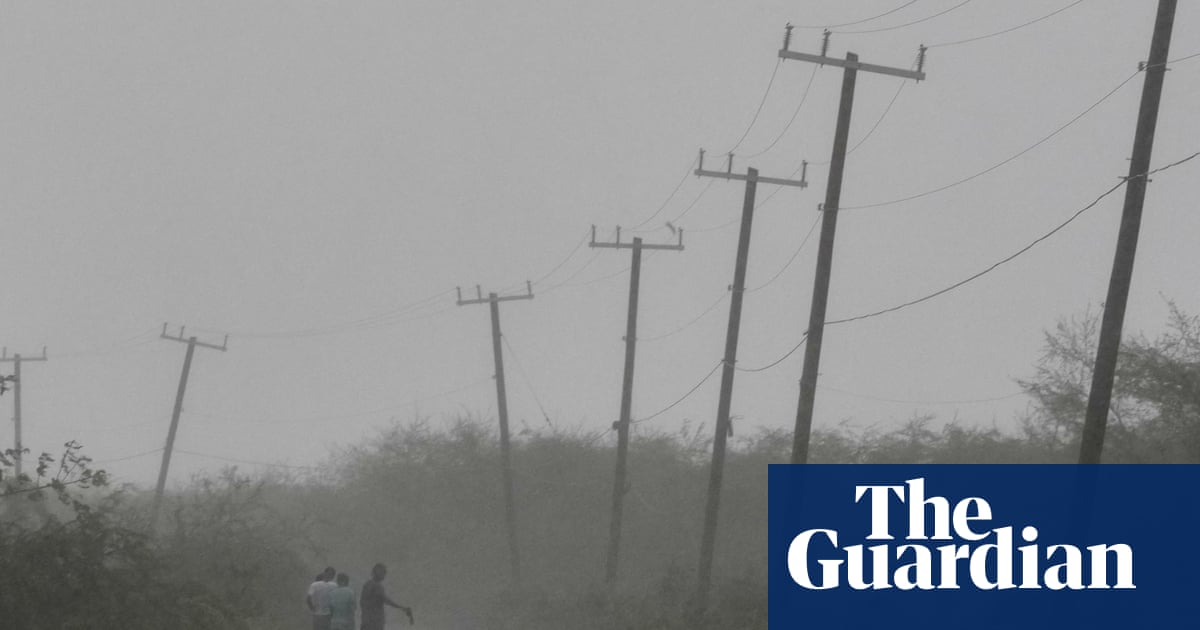

Hurricane Melissa, the strongest storm to hit Jamaica since records began in 1851, made landfall around midday on Tuesday as a catastrophic Category 5 system. With sustained winds near 185 mph, torrential rain and massive storm surge, the hurricane tore down power lines, severed internet connections and destroyed buildings across large parts of the island. Authorities are still assessing the death toll and full scale of the damage.
Melissa has already affected Haiti and the Dominican Republic and, after briefly weakening, has re-intensified and is expected to reach Cuba imminently; Cuban officials have evacuated more than 700,000 people. “The reports that are coming in are catastrophic,” Jamaica’s energy and transport minister, Daryl Vaz, said. “Not very much survives a Category 5 hurricane, in terms of infrastructure.” Melissa is the third Category 5 storm of this Atlantic season, which began in June.
I spoke to Natricia Duncan, the Guardian’s Caribbean correspondent in Kingston, for on-the-ground perspective. Below are the main developments and context.
Key stories elsewhere
– Economy: Rachel Reeves said Britain can defy gloomy forecasts after the fiscal watchdog warned of a large budget gap tied to a productivity downgrade.
– Sudan: Reports of ethnically motivated mass killings and other atrocities in El Fasher after paramilitary forces seized control.
– UK news: Downing Street defended extra spending to house asylum seekers in disused barracks rather than hotels, saying it would ease public concerns.
– Middle East: Israeli airstrikes hit Gaza as tensions test a fragile US-brokered ceasefire.
– Culture: Actress Prunella Scales, best known as Sybil Fawlty, has died aged 93.
Why Melissa is so dangerous
The National Hurricane Center warned that areas hit by the hurricane’s eyewall would face likely “total structural failure,” catastrophic flash flooding and numerous landslides. Forecasters warned storm surge could reach roughly 9–13 feet above ground level near the landfall area, with large destructive waves.
Two features make Melissa particularly perilous: its exceptional wind speeds and its very slow forward motion—moving little more than 2–4 mph at times. That slow crawl prolongs exposure to extreme winds, rain and surge, multiplying damage. Meteorologists note that slow-moving major hurricanes are often among the deadliest and most destructive storms on record because they linger over affected areas.
The Jamaican prime minister, Andrew Holness, urged people to take the warnings seriously: “You have been warned. It’s now up to you to use that information to make the right decision,” he said, adding that he had been praying for the country.
Immediate impact and humanitarian picture
Reports before and after landfall describe widespread damage. Powerful winds felled transmission lines in Saint Elizabeth parish on Jamaica’s south-west coast; mountain and hill communities—where gusts can be stronger—were identified as particularly vulnerable. Kingston officials had not confirmed a full death toll overnight, but regional reporting indicated at least seven fatalities across the Caribbean, including three in Jamaica.
The International Federation of Red Cross and Red Crescent Societies estimated up to 1.5 million people in Jamaica could be affected, a figure their officials cautioned might be low. Jamaican authorities expect roughly 50,000 people could be displaced; some 15,000 were sheltering in official centres in the immediate aftermath. More than half a million people were reported without power, four hospitals sustained damage and one was left without electricity, prompting evacuation of 75 patients.
Local government minister Desmond Mckenzie said parts of St Elizabeth were “under water” with extensive destruction, and warned of severe conditions in Clarendon parish where families remained trapped. It is hoped airports can reopen within days to allow international relief to arrive.
Preparedness, capacity and limits
Jamaica activated hundreds of shelters—officially around 850 sites with capacity for more than 20,000 people—and pre-positioned generators intended to maintain water supplies. Aid agencies had stored food and medical supplies, and so-called strike teams stood ready to reconnect critical services such as hospitals and water treatment plants once it was safe.
Despite preparations, authorities and reporters noted major gaps. Many shelters were overcrowded while some safer facilities were underused; several designated evacuation centres are school buildings not designed for long-term refuge. Informal and poorly built housing—roofs made of zinc sheeting or structures assembled piecemeal—raises concerns that many homes will not withstand the storm. Natricia Duncan described reluctance among some residents to evacuate, citing past experiences of theft or feeling unsafe in shelters.
Haiti’s situation is complicated by a shortage of humanitarian resources: the World Food Programme reported it had only been able to supply around 15% of the food aid it would typically provide, partly because donor attention and funds have been diverted to crises in Gaza and Ukraine. Cuba meanwhile defended its preparedness measures amid criticism that economic strains had limited response capacity.
Recovery priorities
Immediate priorities are search and rescue, restoring power and water, reopening airports and ports for aid, and preventing disease outbreaks by distributing water-purification and cholera-prevention kits. Regional mechanisms—such as the Caribbean Catastrophe Risk Insurance Facility—have been triggered to release emergency funds. Humanitarian agencies have also mapped likely air and sea corridors for supply delivery.
Even with these preparations, officials acknowledge practical limits. As one Jamaican minister put it, preparing for the scale of a Category 5 event is extraordinarily difficult: when infrastructure is swept away, rebuilding becomes a repeated and costly cycle.
The climate connection
Scientists say rapid ocean warming likely played a key role in Melissa’s quick intensification. Warmer seas provide more energy for storms, increasing the chance of rapid strengthening. Jamaican meteorological officials pointed to exceptionally high sea-surface temperatures as a major factor; climate researchers note such conditions are becoming more frequent as the planet warms.
What people are reading and other items
– A long interview with veteran photographer Don McCullin reflects on his career and the ethics of war photography.
– A piece on Awaab’s law examines gaps in housing rights and tenant protections.
– Features on social quirks (like the gender gap in exclamation mark use), debates about diversity in advertising, and actors’ experiences of stage fright.
Sport highlights
– Football: England beat Australia 3-0 in a friendly, with goals from Aggie Beever-Jones, Lucy Bronze and Georgia Stanway, though Michelle Agyemang suffered a knee injury.
– Cricket: England and New Zealand continued a one-day international series.
– Tennis: Cameron Norrie overturned world No 1 Carlos Alcaraz 4-6, 6-3, 6-4 in the Paris Masters, his first win against a reigning top-ranked player.
Front pages and features
News outlets led with fierce language about Melissa—descriptions of a “storm of the century” and comparisons to past catastrophic hurricanes appeared across front pages—alongside coverage of domestic politics and markets.
Today in focus
A longer feature this week traces the recovery of mountain gorilla populations in the Virunga mountains, a conservation success story amid broader environmental crises.
A small hopeful note
The Upside column profiles people finding positive life changes: one mother who began running after joining a junior parkrun with her daughter now trains for a marathon and has rediscovered a healthier relationship to exercise.
What to expect next
Assessments of damage and loss will continue over the coming days as emergency teams reach cut-off communities and airports reopen. International aid will be crucial to the response, but Jamaican officials have stressed the scale of the challenge and warned that full recovery will be slow. The intensification and impact of Melissa have also renewed debate about climate risk and the growing vulnerability of small island states to extreme storms.
For those wanting to help: monitor national and international humanitarian agencies for vetted donation channels and guidance on the best way to support relief efforts.