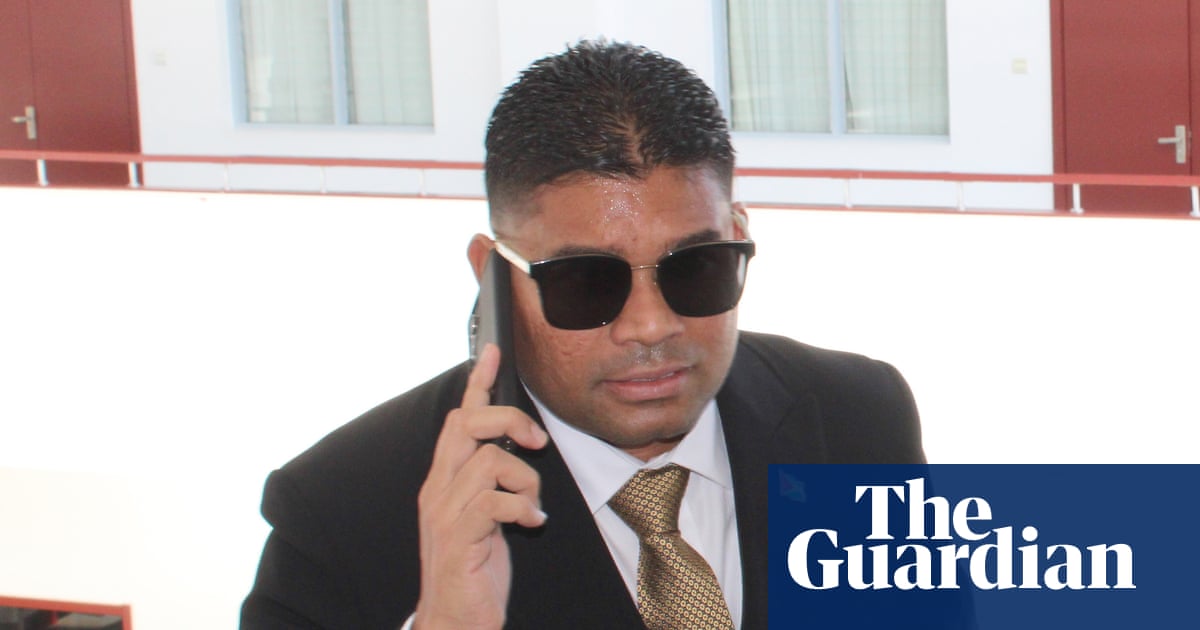

Guyana has been plunged into political turmoil after the arrest and possible extradition to the United States of Azruddin Mohamed, the country’s main opposition leader, and his father Nazar Mohamed. The arrests on 31 October in Georgetown came two months after Azruddin Mohamed emerged as a surprise presidential contender in the election that kept incumbent Irfaan Ali in power.
Both Azruddin, 38, and Nazar, 73, who are prominent figures in Guyana’s gold mining sector, face an 11-count indictment in a Florida court that includes allegations of money laundering, bribery and tax evasion. They were released the same day on bail of 150,000 Guyanese dollars each, about £547 or $720, and ordered to report weekly to the court. A further hearing was scheduled for the following Monday.
Mohamed has denied wrongdoing and accused President Ali’s government of political persecution, saying the administration is behind the sanctions and has agents in the United States. Guyana’s attorney general, Mohabir Anil Nandlall, countered that the arrests were a legal obligation under Guyana’s international commitments, noting that a 1931 extradition treaty between the UK and the US remains in force in Guyana since independence in 1966.
The case has drawn extra scrutiny because of expanding US commercial interest in Guyana’s offshore oil industry. American companies lead much of the exploration that could transform Guyana into one of the world’s largest oil producers per capita, even as more than half the population remains in poverty. Observers say the emergence of Mohamed’s movement has unsettled the political status quo.
Mohamed launched his own party and declared a presidential bid three months before the vote, breaking a long-standing two-party dynamic that typically places the PPP/C, broadly supported by Indo-Guyanese voters, against the APNU, generally backed by Afro-Guyanese voters. Campaigning on a populist, anti-establishment platform and urging a rejection of ethnic bloc voting, he pushed to renegotiate the oil deals. His party unexpectedly won 16 of 65 seats in the new parliament, becoming the main opposition force ahead of the APNU’s 12 seats; the incumbent PPP/C secured 36 seats.
Three days after his arrest and release, Mohamed was sworn in as a member of the new parliament. He arrived at the legislature in the Lamborghini at the centre of an alleged mail fraud case in the US, which accuses him of submitting a false invoice of $75,300 for a vehicle claimed to have cost $680,000.
Although the US extradition request was formally submitted last October, the US investigation reportedly covers alleged conduct from 2017 to 2024. In June 2024 a shipment of roughly $5.3m in gold bars sent from a Mohamed company was seized at Miami International Airport. That same month the US Treasury announced sanctions against the Mohameds, accusing them of gold smuggling, evading more than $50m in taxes owed to Guyana and bribing local officials.
Vice-president Bharrat Jagdeo, who served as president from 1999 to 2011, said the extradition request carried the signature of Marco Rubio, whom he described as the US secretary of state, and argued the matter underscored Guyana’s treaty obligations. Mohamed and his lawyers have so far declined to comment to the press but have previously rejected the allegations.
Mohamed’s legal team says some of the conduct cited in the US indictment is not an offence under Guyanese law and that he should not be surrendered to US authorities. They plan to challenge the extradition in Guyana’s courts, including the constitutional court, and ultimately at the Caribbean Court of Justice. Political analysts expect the legal proceedings to be protracted and say Mohamed, who remains a member of parliament, is likely to keep using his parliamentary platform to challenge the government.